
Skip to content Skip to side menu

Goodson Gazette

The Whys and Hows of Demagnetizing Engine Components

In my mind, not demagnetizing components you’ve worked on is kind of like taking a bath, then putting your dirty clothes back on. Doesn’t make a lot of sense and undoes all of the good work you’ve just done. So here goes. This is my view on whether or not to demag components:

Read more →

Tips for Choosing the Right Flywheel Grinding Stone

We hear a lot of shops complaining that they don’t have time to stop and change the grinding stone every time they start on a new flywheel. First, let me congratulate you that your shop is busy. Second, let me tell you that you’re wasting more time by not changing the stone than you are by changing it. If you try to grind a flywheel with a stone that’s too hard or too soft for the material the flywheel is made of, you’re going to spend more time dressing the stone and grinding the flywheel that you would if you used the correct stone to begin with.

Read more →

Protect Your Eyes in The Shop – Take My Word For It, It’s Important

You’ve probably heard the warnings to wear eye protection hundreds of time; maybe even to the point that you just don’t hear it anymore. Well, I’m here to re-emphasize that eye protection is absolutely essential!

This is a case of do as I say, not as I do because I’m ashamed to admit that I didn’t follow my own advice and now I’m paying for it.

Read more →

The Nitty Gritty of Abrasive Safety

The Nitty Gritty of Abrasive Safety

Goodson wants you to stay safe when using abrasives in engine building. We've compiled a list of use and safety tips for abrasive use in basic machining operations including valve grinding, seat grinding, head surfacing, cylinder honing, cam grinding, crankshaft grinding & polishing and flywheel grinding.

Read more →

Tips for Using a Diamond Dressing Tool

Tips for Using a Diamond Dressing Tool

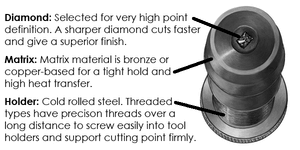
Diamond dressing tools are used in a wide variety of shop machines; everything from the valve refacer to the flywheel grinder to the crankshaft grinder. Knowing how to use your diamond dressing tools will result in longer life for the dresser AND the abrasive.

Read more →

Tips and Tricks for Installing Bronze Liners

Using bronze liners is one of the fastest and easiest ways to repair valve guides. Here are a couple of tips to make it even easier.

Use a centering cone

With the cone centered on the existing valve seat and the extended pilot of the boring reamer located in the existing guide, boring alignment is assured. With accurate alignment of the new guide, minimal seat work will be required to finish.

Read more →

Taking the Guesswork Out of Leak Testing

One of the most popular uses of a vacuum tester is the testing of valves and valve seats. After resurfacing valve and seats to ensure a gas-tight seal, we can test that seal with vacuum.

Read more →

The valve refacer … the machine that makes a good valve job a great valve job!

Dave Monyhan (retired) gives tips for proper maintenance of your Valve Refacer. Proper understanding of the machine and how to maintain it will improve your valve jobs, keeping you profitable and your services in demand.

Read more →

Finishing valve seats on today’s multi-valve heads

One of the most frequently asked questions on our tech line today is: “What is happening to my valve seats? I’ve tried everything! A new stone, stone holder, pilot and even a new dressing diamond but I can’t achieve seat alignment.” Get some ideas for how to finish valve seats in multi-valve heads.

Read more →

Tips and tricks for fast and accurate crack detection

Dry Method Magnetic Particle Inspection
When “Magnafluxing” a casting, never blast with media prior to testing. Blast media peens the surface and can move metal, possibly closing the very cracks or flaws that you are trying to identify. When very coarse wire brushes are used roughly, they can also mask these areas.

Read more →